
Understanding Cavity Fire Dynamics in Exterior Wall Assemblies
23 Oct 2026
How Airflow, Heat Release and Façade Geometry Influence Fire Behavior
Many ventilated and non-ventilated façade systems incorporate a cavity within the exterior wall assembly. The cavity is typically a narrow space behind the exterior cladding, often bounded by insulation or sheathing on the inner side. Its continuity depends on cavity barriers and other assembly details. This space can support drainage and, in ventilated systems, airflow. During a fire, however, its geometry can affect how flames, hot gases, and heat move through the wall assembly.
Material-level data such as heat release rate, critical heat flux, and ignition temperature helps characterize individual components. Those values alone cannot predict how the components will interact within a complete assembly under fire exposure.
The Physics of Fire Within the Cavity
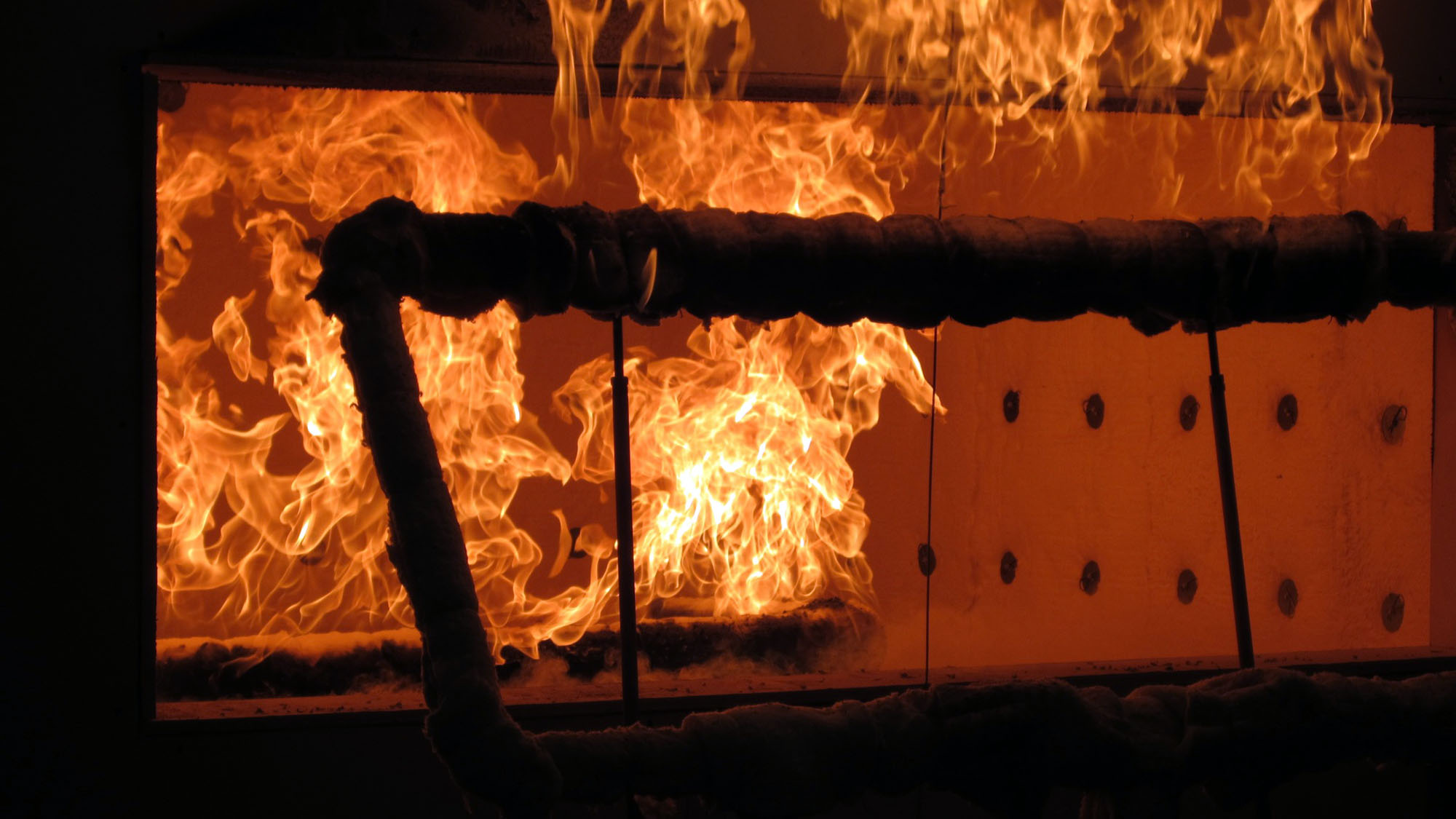
Fire behaves differently inside a confined vertical cavity than it does in open space. Three related mechanisms help explain that behavior: chimney effect, limited air entrainment, and flame stretch.
Heated gases become less dense and rise. Where openings permit airflow, this buoyancy-driven movement can draw cooler, oxygen-rich air into the cavity from below. That oxygen supply can feed combustion and increase vertical flame spread.
A confined cavity also limits lateral air entrainment. If the oxygen supply is insufficient for the available fuel, the fire can become ventilation-controlled. Heat can continue to pyrolyze nearby combustible materials, producing unburned gases that move upward. At panel joints, window openings, parapets, or other discontinuities, these gases may encounter fresh air and ignite if temperatures and mixing conditions are sufficient.
Within a narrow channel, surrounding surfaces restrict flame expansion and lateral air entrainment, which can cause flames to extend farther upward. The resulting flame stretch can expose materials higher in the wall to sustained heat and preheat areas ahead of the main fire front.
Heat Release, Radiant Feedback and Material Interaction
Classifying individual materials as combustible or non-combustible does not fully describe assembly fire performance. Heat release, radiant feedback, and interaction among components also affect fire development.
Peak heat release rate and total heat release describe the rate and total amount of energy a material releases during combustion under test conditions. Smaller components can influence wall performance alongside major materials such as insulation and cladding.
Bench-scale methods such as cone calorimeter testing provide material-level data, but do not reproduce every condition within a cavity. Radiative heat exchange between flames and surrounding surfaces can increase material temperatures. Heated surfaces can then reradiate energy into the cavity, contributing to further heating.
Combustible weatherproofing membranes can heat rapidly because of their high surface-area-to-mass ratio and low thermal mass. Exposure to flame or intense radiant heat can lead to ignition and further fire development.
External Plume Interaction and Façade Geometry
Flames and hot gases can escape a cavity through window openings, panel joints, or other discontinuities. The rising external plume can remain close to the façade and heat surfaces above the opening. Continued fire spread within the cavity can expose materials to heat from both inside and outside the assembly.
Deep window reveals, recesses, and inside corners can increase radiant heat exchange between facing surfaces and reduce heat dissipation. Horizontal projections such as balconies, sunshades, overhangs, and fins can interrupt an upward-moving flame plume, causing flames and hot gases to spread laterally beneath the projection and potentially reach nearby openings or cavity spaces.
Stepped façades, sloping forms, and other geometric transitions can produce cavities of varying depth, direction, and volume, disrupting airflow and creating turbulence and changing pressure conditions. These transitions can also complicate cavity barrier detailing and installation, particularly where a continuous seal is difficult to achieve.
Evaluating the Complete Wall Assembly
These interactions call for evaluation of the wall assembly as a system. Full-scale wall assembly testing evaluates component interaction under defined fire exposure. Material-level data and computational fluid dynamics modeling can also support analysis of cavities, corners, overhangs, and other complex features. Modeling requires appropriate validation and consideration of its assumptions and limitations; it does not automatically replace testing required by applicable codes.
Intertek provides fire testing and evaluation services for building products and exterior wall assemblies.

You may be interested in...

Fire Testing | Fire Safety and Certification
Complete suite of fire and flammability testing solutions to ensure your products comply with your local, regional, or national building codes.