
Designing Medical Devices for the Harsh Realities of Emergency Care
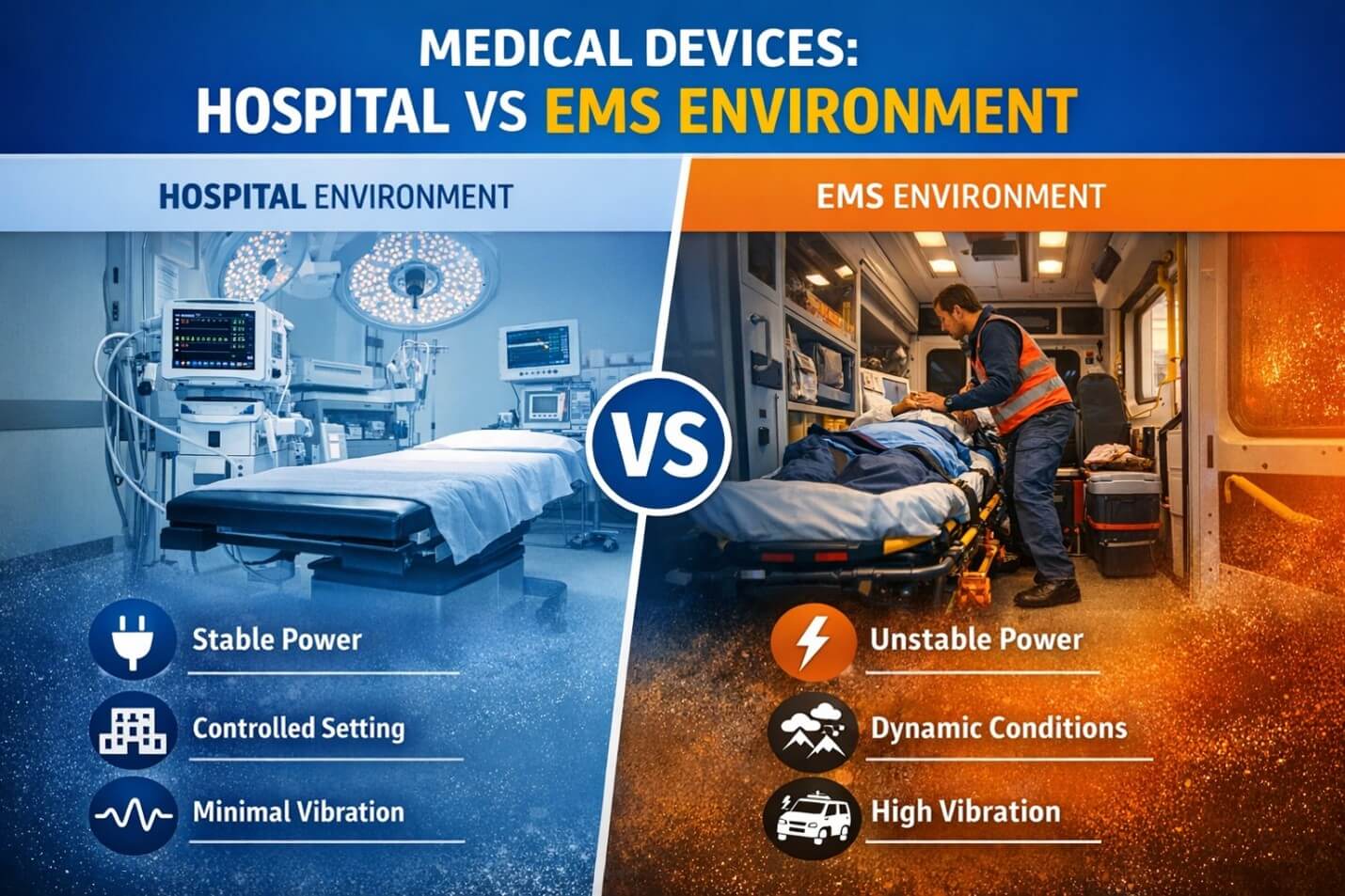
Medical devices used in emergency medical services (EMS) operate in environments far removed from controlled hospital settings. Ambulances, helicopters, and outdoor emergency scenes expose equipment to constant vibration, mechanical shock, unstable power sources, temperature extremes, and unpredictable electromagnetic conditions.
IEC 60601-1-12 addresses these realities by defining requirements for medical electrical equipment and systems intended for use in EMS environments, ensuring devices remain safe, effective, and reliable when and where they are needed most.
What is IEC 60601-1-12?
IEC 60601-1-12 is a collateral standard within the IEC 60601 series that specifies requirements for medical electrical equipment and systems used in the emergency medical services environment.
Within the IEC 60601 framework:
- IEC 60601-1 defines general safety and essential performance
- IEC 60601-1-12 addresses EMS-specific environmental and operational conditions
- IEC 60601-2-XX standards define product-specific requirements
IEC 60601-1-12 ensures medical devices continue to perform safely and reliably in the unpredictable, high-stress conditions of emergency care.
Why IEC 60601-1-12 Matters
Unlike traditional healthcare environments, EMS settings introduce unique and intensified risks. Devices must function correctly despite:
- Continuous vibration from moving vehicles
- Mechanical shocks during transport or handling
- Power fluctuations from vehicle electrical systems
- Exposure to outdoor elements and temperature changes
- High electromagnetic activity from communication systems
Failure in these environments can directly impact patient outcomes during critical moments.
For engineering, quality, and compliance professionals, this standard helps answer a vital question: “Will this device still perform safely when used in the back of a moving ambulance or at an emergency scene?”
What Products Are Within Scope?
IEC 60601-1-12 applies to medical electrical equipment and systems intended for use in EMS environments, including both transport and field use.
Common in-scope devices include:
- Patient monitors used in ambulances
- Defibrillators and AEDs
- Ventilators designed for transport
- Infusion pumps for emergency care
- Portable diagnostic equipment
- EMS stretchers and integrated systems
If a device is intended for use outside controlled clinical environments, particularly in transport or emergency response scenarios, IEC 60601-1-12 is likely relevant.
What Does IEC 60601-1-12 Require?
IEC 60601-1-12 builds on the base standard by introducing environmental and operational stress conditions specific to EMS use. Key EMS environmental considerations include the following:
| Condition | What It Means for Device Design |
| Vibration | Continuous exposure during transport must not degrade performance |
| Mechanical Shock | Devices must withstand drops, impacts, and sudden movement |
| Power Supply Variability | Equipment must operate safely with unstable or vehicle-based power |
| Temperature Extremes | Performance must be maintained in hot, cold, and fluctuating conditions |
| Electromagnetic Disturbances | Devices must function reliably alongside radios and communication systems |
| Mobility & Handling | Equipment must remain safe and usable during transport and rapid deployment |
These are not outliers or edge cases; they are normal operating conditions in EMS environments.
How IEC 60601-1-12 Fits Into Product Development
IEC 60601-1-12 should be considered early, particularly for devices intended for transport or field use.
- During concept and planning, manufacturers determine whether EMS use is part of the intended application and identify applicable standards.
- During design and engineering, products are built to withstand environmental stresses such as vibration, shock, and power variability.
- During verification and testing, devices are evaluated under simulated EMS conditions to confirm safety and performance.
- During regulatory submission, this evidence supports claims that the device is suitable for emergency use environments.
Designing for EMS after the fact is difficult. This standard is most effective when applied from the start. If unsure whether EMS is a standard that should be considered, Intertek can provide consulting services unaffiliated with our laboratory testing and certification services that can help you best understand the regulatory road ahead.
Relationship to Other Key Standards
Medical devices intended for use in emergency medical services environments must meet a combination of general, collateral, and particular standards. While IEC 60601-1-12 defines the environmental and operational conditions specific to EMS use, it is typically applied alongside other standards that address safety, usability, electromagnetic compatibility, and device-specific performance requirements.
Core and Collateral Standards for EMS Equipment
| Standard | Focus Area | Why It Matters for EMS Devices |
| IEC 60601-1 | General Safety & Essential Performance | Establishes baseline safety requirements for all medical electrical equipment |
| IEC 60601-1-2 | Electromagnetic Compatibility (EMC) | Ensures devices perform reliably in environments with radios, communication systems, and interference |
| IEC 60601-1-6 | Usability Engineering | Ensures devices can be safely and effectively used in high-stress EMS environments |
| IEC 60601-1-12 | EMS Environment | Defines environmental and operational conditions specific to transport and emergency use |
Together, these standards help ensure devices remain safe, reliable, and usable in real-world emergency conditions.
Common Particular Standards for EMS Medical Devices
| Standard | Device Type | EMS Relevance |
| IEC 60601-2-4 | Cardiac Defibrillators & Defib-Monitors | Critical life-saving equipment used in emergency response |
| IEC 60601-2-27 | ECG Monitoring Equipment | Continuous monitoring during transport |
| IEC 60601-2-25 | Diagnostic Electrocardiographs | Explicitly applicable in ambulance and transport environments |
| IEC 60601-2-49 | Multifunction Patient Monitors | Widely used in EMS for multi-parameter monitoring |
| IEC / ISO 80601-2-12 | Critical Care Ventilators | Commonly used in transport and emergency respiratory support |
| IEC 60601-2-24 | Infusion Pumps & Controllers | Used for controlled drug delivery in emergency care |
| IEC 60601-2-30 | Non-Invasive Blood Pressure Monitors | Routine monitoring in EMS settings |
| IEC 60601-2-34 | Invasive Blood Pressure Monitors | Used in advanced or critical care transport scenarios |
| IEC 60601-2-10 | Nerve & Muscle Stimulators (TENS) | Used in certain emergency or therapeutic applications |
Common Challenges Manufacturers Face
Developing devices for EMS environments introduces several challenges:
- Underestimating real-world environmental stress conditions
- Designing for hospital use, then adapting for EMS too late
- Difficulty replicating field conditions during testing
- Integrating multiple standards into a cohesive compliance strategy
- Managing trade-offs between durability, usability, and performance
These challenges can lead to redesigns, delays, or unexpected compliance gaps.
Why Intertek for IEC 60601-1-12 Testing and Compliance
Intertek helps manufacturers bridge the gap between controlled lab design and real-world EMS performance. Our teams support EMS device compliance by:
- Evaluating applicability of IEC 60601-1-12 early in development
- Designing test programs that reflect real-world EMS conditions
- Integrating safety, EMC, environmental, and performance testing
- Identifying risks before they become costly design issues
- Supporting global certification and market access
With experience across transportable and emergency-use medical technologies, Intertek provides clear guidance and dependable execution to help manufacturers deliver devices that perform when it matters most.
IEC 60601-1-12 - Frequently Asked Questions (FAQs)
No, IEC 60601-1-12 applies specifically to devices intended for use in EMS environments, including transport and field use.
No, IEC 60601-1-12 supplements the base standard with additional environmental and operational requirements.
Not without risk. Devices not designed for EMS conditions may fail or perform unpredictably in those environments.
As early as possible, especially if EMS use is part of the intended application.
Related Links
You may be interested in...
Designing Medical Devices for Real-World EMS Conditions | White Paper
Medical devices used in Emergency Medical Services face extreme conditions far beyond the hospital. This white paper explores how IEC 60601-1-12 and IEC 60601-1-2 requirements help manufacturers design for vibration, power instability, environmental stress, and high RF exposure to ensure essential performance when it matters most.

Overview of IEC 60601-1 Standards and References
End-to-end solutions from product development and risk management file reviews to comprehensive testing to the IEC 60601-1 series.
Knowledge Center
Download the latest information from our medical device compliance experts.
Six Medical Device Trends Shaping 2026
Six Strategies for Medical Device Compliance in 2026
Medical EMC In-Situ Testing: On-demand Webinar | White Paper
IEC 81001-5-1 and Cybersecurity for Medical Devices Webinar
Six Compliance-Related Questions About Connected Home Healthcare Devices
Accelerated Stress Testing for Medical Devices
Machine Learning and Artificial Intelligence (AI) in Medical Devices: Webinar | Fact Sheet
IEC 60601-1-2 Ed. 4.1 Overview of Requirements
Medical OEM Wireless Coexistence Testing
Biocompatibility Risk Assessment and Evaluation Plans
For more expert papers, recordings, and presentations, visit our Medical Resources hub.
Follow Us For More!
We’re always adding new content and looking for ways to help you simplify the regulatory and compliance process for medical devices.
** The Intertek legal entities that provide medical device management system certification services (including ISO 13485 and MDSAP) and Notified Body services (MDR 2017/745 and MDD 93/42/EEC) do not provide any consulting services. Clients who have used other Intertek legal entities’ consulting services are not eligible to receive management system certification services or Notified Body services from Intertek.